




SFJ’s Threat Against the Indian Consulate
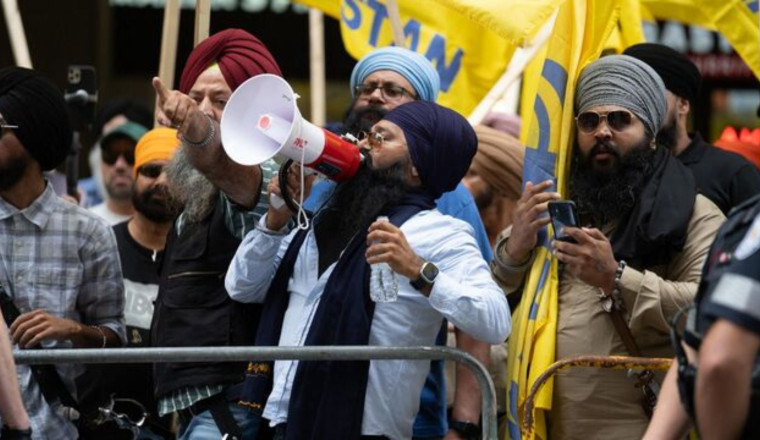
SFJ has declared that on Thursday, September 18, 2025, it will take over the Indian Consulate in Vancouver. The group issued a warning to Indo-Canadians who had scheduled visits to the consulate, urging them to postpone their plans.
In a move designed to provoke, SFJ also released a poster with the image of India’s new High Commissioner to Canada, Dinish Patnaik, with a target on his face. The poster accuses Indian diplomatic missions of running “spy networks” against Khalistani activists in Canada.
Allegations Against Indian Missions
In its statement, SFJ referenced Canadian Prime Minister Justin Trudeau’s 2023 remarks in Parliament, where he claimed that Indian agents were under investigation for their alleged role in the assassination of Hardeep Singh Nijjar, a prominent Khalistani figure. Nijjar’s killing had sparked massive diplomatic tension between the two countries.
SFJ alleges that two years later, Indian consulates continue to conduct surveillance on Khalistan Referendum campaigners. They further claimed that the situation was so dire that Canadian authorities had to provide witness protection to Inderjeet Singh Gosal, who assumed leadership of the Khalistan Referendum campaign after Nijjar’s death.
According to SFJ, the planned “siege” aims to demand accountability from India for what they describe as “espionage and intimidation on Canadian soil.”
No Response From India Yet
At the time of reporting, neither the Indian Ministry of External Affairs (MEA) nor the Indian Consulate in Vancouver had issued an official statement on SFJ’s threat. However, given the history of tensions, this development is expected to further complicate the fragile process of normalizing relations between New Delhi and Ottawa.
Khalistani Extremism in Canada: A Growing Concern
The threat comes shortly after an internal Canadian government report acknowledged that extremist Khalistani groups in Canada were receiving financial support from local individuals and networks.
Some of these groups include:
-
Babbar Khalsa International (BKI)
-
International Sikh Youth Federation (ISYF)
Both organizations are listed as terrorist entities under Canada’s Criminal Code. However, experts note that these groups often operate indirectly, using smaller, loosely connected networks to promote the Khalistan cause without being formally tied to banned organizations.
The persistence of these groups highlights a key concern: while Canada officially bans certain extremist organizations, Khalistani activism continues to find safe havens in the country through softer fronts and pressure groups like SFJ.
Implications for India-Canada Relations
The timing of SFJ’s threat is significant. After months of strained ties—particularly following Trudeau’s comments in 2023 and India’s retaliatory measures—both countries had recently resumed diplomatic dialogue. This new provocation threatens to derail that progress.
For India, such threats are more than just political rhetoric; they represent a direct challenge to the security of its diplomats and missions abroad. For Canada, the issue reflects a delicate balancing act between freedom of expression and preventing extremist activities on its soil.
If not handled with caution, these incidents could push India-Canada relations back into another cycle of mistrust and hostility.
Conclusion
The threatened siege of the Indian Consulate in Vancouver by SFJ underscores the continuing challenge posed by Khalistani extremism in Canada. While framed as activism, such actions risk escalating tensions between India and Canada, putting diplomats, Indo-Canadian citizens, and bilateral relations at stake.
Unless Canada takes stricter action against extremist outfits misusing its democratic freedoms, the dream of stabilizing ties with India may remain elusive.












Comments
0 comment